A Boy Outside a Bombay Airport Stayed With Him. This Is Part of the Journey That Built Toronto Joy.
A Boy Outside a Bombay Airport Stayed With Him. This Is Part of the Journey That Built Toronto Joy.
How Amar Khanderia’s 17 years between two worlds, and one unforgettable moment outside a Bombay airport, became part of the longer journey that quietly shaped the foundation for Toronto Joy. There’s a boy. No legs. One arm. And
How Amar Khanderia’s 17 years between two worlds, and one unforgettable moment outside a Bombay airport, became part of the longer journey that quietly shaped the foundation for Toronto Joy.
There’s a boy. No legs. One arm. And he’s grabbing onto Amar’s leg.
Amar was around 14 or 15. It was 1996, and his family had brought him to Bombay for a visit. He came out of the airport and was waiting when he felt it. Small hands. Then he looked down and saw the boy’s eyes looking straight up at him.
He already knew suffering existed. But knowing something and having it hold onto your leg outside an airport are two completely different things. That moment didn’t hand him a life plan. It stayed with him, quietly, the way certain things do. Years later, it would become one thread in a much larger journey, a journey that eventually led to Toronto Joy.
Table of Contents
ToggleA Search That Didn’t Look Like One
Amar grew up in Toronto. Friends, family, university, a semester abroad in Copenhagen; by most measures, life was full. But there was a feeling that followed him across countries he couldn’t quite name. “I had experienced many things,” he says. “Friends, my parents, all of that. But I still felt something was missing.”
After university, India called again, this time as a young man in his early twenties. What began as a visit became something else entirely.
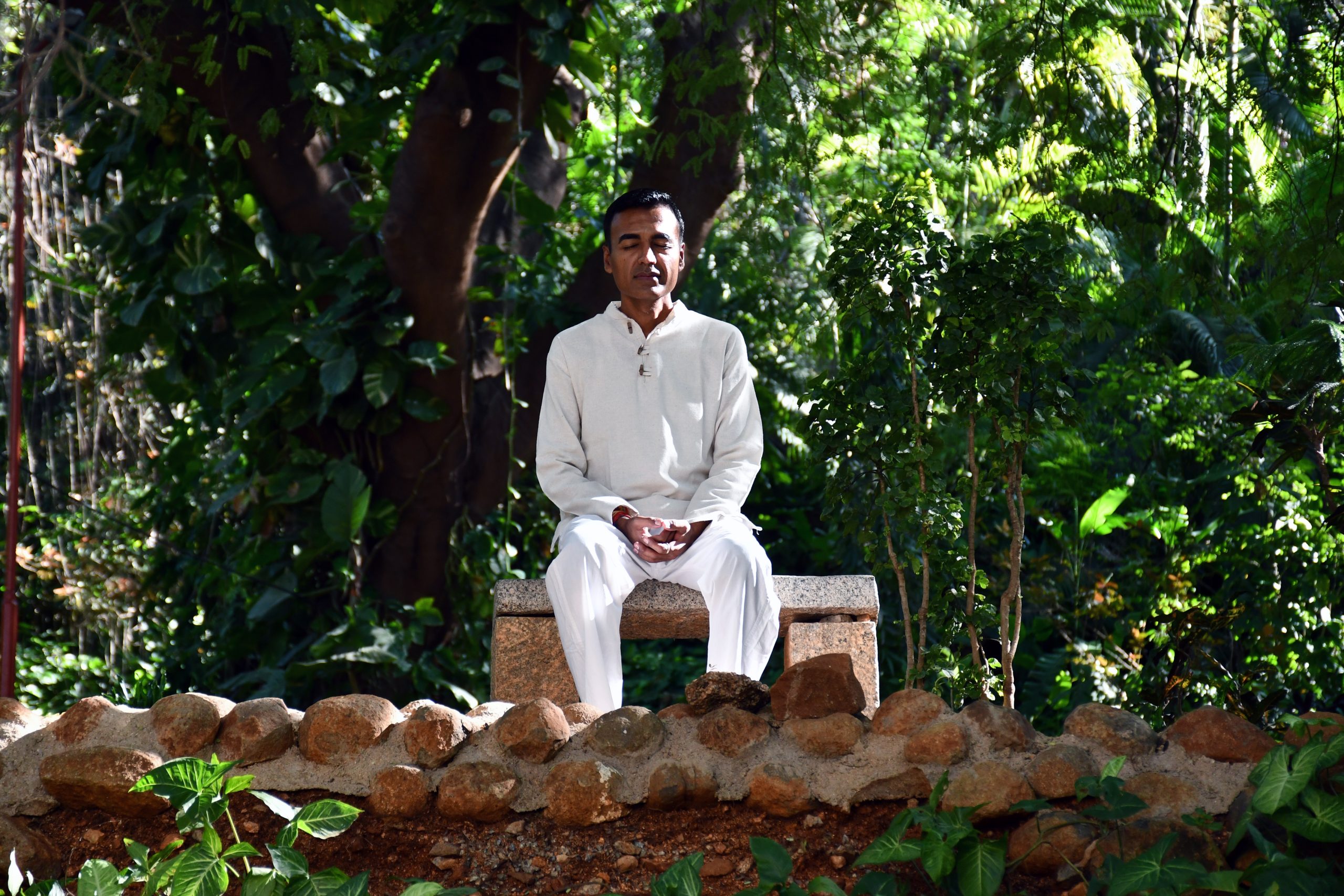
In 2003, on the advice of a close friend, Amar went to meet a spiritual teacher in South India. What began as a visit out of respect for his friend slowly became something much larger. A few days later, he travelled to her ashram, a small, quiet hamlet surrounded by coconut trees and sandy pathways, where Sri Vasantha Sai, known to those around her simply as Amma, lived and taught. He ended up staying for seventeen years.
The Life He Chose and What It Cost Him
People assume that a spiritual path means stepping away from difficulty. Amar is quick to correct that.
“It takes a lot of work to raise a family, earn a living, have a successful career and deal with life’s challenges,” he writes in his memoir, Walking with Shakti. “And it takes an equal amount of tenacity and grit to transform within, to mend habits and tendencies, deal with and strive to rise above anger, greed, lust, jealousy. It is not a walk in the park.”
The ashram ran from 4 a.m. to 9 p.m.: meditation, chanting, service, spiritual talks. There was little room to avoid yourself. Whatever was inside you eventually came up. Anger, jealousy, ego, fear, insecurity. All of it.
Once, he went to Amma and told her he felt like things kept going in circles, one thing got worked through and the next appeared.
She said: imagine seven mountains in front of you. You must climb the first one, then come down before you can climb the second. When you think you’re going down, you’re not really going down. You’re being taken to your next up.
83 Villages and a Nun at Bodh Gaya
Alongside the inner work, there was outer work, real, physical, unglamorous work. Amar was involved in supporting service initiatives that reached 83 villages: education programs, vocational training, food distribution, clothing support, and two water plants producing more than 200,000 litres of clean drinking water every day.
Those numbers are real. But what changed him was not simply the scale of the work. It was experiencing service from within, seeing what happens when you stop thinking only about yourself long enough and become genuinely useful to someone else.
During a pilgrimage to Bodh Gaya, he walked around the Bodhi tree, lit a candle, and asked a nun there to bless him to attain nirvana. She laughed. “How is that possible?” she asked, “if you have not served?”
He didn’t take it as a formula. What he understood was something more subtle: that through service, you stop thinking only about yourself. You begin to think of others. And that shift changes something in the person doing it. It creates a little more space within and gradually moves your attention away from the constant focus on the ego and the “I.”
Coming Home—and Seeing the Gap
“I moved back to Canada after my time with Amma at the crux of the pandemic,” he writes. “It wasn’t an easy decision, as I wasn’t sure what I was going to do. I was adjusting to the old yet new environment; trying to find my place.”
He worked with an organization that supported initiatives for CAMH, Amnesty International, Plan International, and The Nature Conservancy. Each organization was different, but the thing he kept noticing was the same: when people show up with a genuine intention to help, something shifts in them too. He had seen it in India. He kept seeing it here.
But he also kept seeing a gap. People who genuinely wanted to contribute didn’t know where to start. Organizations that needed support couldn’t find them. Nobody was quite bridging the two in a way that felt like it actually worked.
What a Hairnet Can Teach You About Belonging
Toronto Joy launched in 2025. The idea is almost embarrassingly simple: bring people together to serve, and let the rest follow.
One of the early events paired a kitchen shift at Good Shepherd Ministries, hairnets, gloves, hundreds of meals to prepare, with a wind-down at Eataly afterward. The combination was intentional. “When people are in hairnets, gloves, and aprons, working beside each other to get food ready, the usual identity games don’t matter as much,” Amar explains. “It becomes simple. There is a task. There is a need. There are people to serve.”
He has watched it happen: someone arrives guarded. A joke gets made. Someone asks where they’re from. By the end of the shift, the same person who arrived reserved is smiling, taking photos, asking when the next opportunity is. “Transformation doesn’t always have to be dramatic,” he says. “Sometimes it’s just someone feeling safe enough to be human again.”
Toronto is also a city where thousands of people rely on the shelter system on any given night, and loneliness runs quietly underneath. Alongside Toronto Joy, Amar runs The Journey Home, where a global community gathers online around authenticity, leadership, and inner work.
The Boy Outside the Airport
Amar still thinks about that boy in Bombay, the one he first saw as a teenager, whose eyes looked straight up at him outside the airport in 1996. That moment never left him. It didn’t give him a blueprint. But it opened something. Seventeen years in India, then the return home, then the nonprofit work, then watching the same gap appear over and over, all of it is part of the same long road. The boy was one early step on it.
Gandhi said the best way to find yourself is to lose yourself in the service of others. Amar spent seventeen years learning, firsthand, why that’s true. “When we serve with sincerity,” he says, “something shifts. We are no longer so caught in ourselves. We create space within. We feel more connected, more balanced, more alive. At the same time, someone else is helped. So it becomes a beautiful thing for both sides.”
Now he’s building a space for the rest of us to find out.
Ready to be part of something real? Toronto Joy brings people together to connect, serve, and actually show up for the city: one gathering, one kitchen shift, one new face at a time. Whether you want to volunteer, collaborate, or simply find your people, the door is open.
Explore upcoming events and learn more at www.torontojoy.org.
Rob Pene is the chief growth guy at Mission Driven Brand. He writes about the intersection of purpose, leadership, and community — the people and organizations building something that matters beyond the bottom line.
Read us often? Make Thought Leaders Ethos™ a preferred source in Google Search and see our reporting more often in Top Stories.